As a player who grew up with the Nintendo 64 and GameCube era of Paper Mario, I have spent years wondering whether any indie studio could capture that same paper-thin magic. Then I stumbled across Moonsprout Games' Bug Fables, and I felt a familiar spark. When I first watched the trailer, everything looked straight out of 2001. The visuals and animation were near-perfect recreations of what made Paper Mario stand out when it released on the N64. The irreverent dialogue and charming humor were equally on point. If I was looking for a spiritual sequel to The Thousand-Year Door, this looked like it might be it. 🐞✨
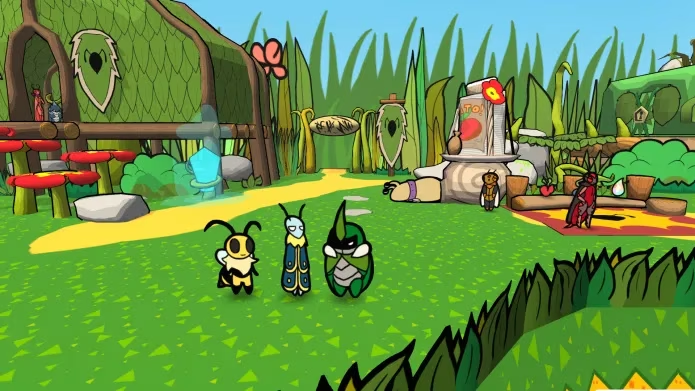
A Love Letter to Paper Mario's Golden Era 🎮
Now, in 2026, I can look back at Bug Fables with even more appreciation. The game was not just a rehash of the Paper Mario formula. Moonsprout Games added a few modern sensibilities to their adventure RPG. When I am in combat, I can use action commands to make my attacks and defenses more effective. That timing-based system keeps every battle engaging, just like the classic games did. And the game also features a crafting-like cooking system. This lets me take resources and turn them into items that further my battle prowess. It is a small addition, but it gives the journey a satisfying layer of preparation and discovery.
Was I less-than-thrilled with 2016's Paper Mario: Color Splash? I was not alone. Many fans felt that the series had drifted away from its RPG roots. Bug Fables, however, wears its inspiration firmly on its sleeve. This is an adventure RPG through and through. The team at Moonsprout Games clearly understood what made the older entries beloved: memorable partners, turn-based combat, a world full of quirky characters, and a story that balances humor with genuine stakes.
Not Just Nostalgia: Modern Touches That Matter 🛠️
What keeps me coming back to Bug Fables in 2026 is how it respects my time while still honoring its inspirations. The action commands are not just window dressing. They reward attention and rhythm. The cooking system is not overly complex, but it encourages me to explore every corner of the world. I can gather ingredients, experiment with recipes, and create items that turn a tough boss fight into a tactical puzzle. That is the kind of design that makes an RPG feel alive.
Moreover, the dialogue is sharp. The humor is irreverent without becoming cynical. The characters have personality, and the world feels handcrafted. I often ask myself: why do so many modern RPGs forget that charm matters? Bug Fables remembers. It remembers that a great adventure can be funny, heartfelt, and challenging all at once.
Demo, Platforms, and a 2026 Reality Check 📅
When the game was first announced, the team put out a short demo that I could download and try on PC. That demo was a smart move. It gave players like me a deeper idea of what was in store. At the time, Bug Fables was coming to Nintendo Switch, PC, and PS4 in September. In 2026, that September launch is long behind us, and the game has become a cult classic for fans of classic-style RPGs. The initial promise has aged remarkably well. The visuals still pop, the combat still clicks, and the humor still lands.
If you are on the fence today, should you care about a game that was originally pitched as a throwback? Absolutely. In an era of massive open worlds and live-service grinds, Bug Fables offers something refreshingly focused. It is a compact, joyful adventure that knows exactly what it wants to be. Whether you play it on Switch, PC, or PlayStation, the core experience remains intact.
Key Features at a Glance 🔍
| Feature | Why It Matters |
|---|---|
| Paper Mario-inspired visuals | Nostalgic, expressive, and full of charm |
| Action commands | Active, timing-based combat that keeps you alert |
| Cooking/crafting system | Turns resources into useful battle items |
| Irreverent dialogue | Humor that respects the player's intelligence |
| Adventure RPG structure | Exploration, partners, and turn-based battles |
I have to admit: I am biased. I love the older Paper Mario games, and I miss that style. But Bug Fables is not merely a copy. It is a love letter with its own voice. The bugs are not Mario and friends, but they carry the same spirit of adventure. The world is not the Mushroom Kingdom, but it is filled with secrets, side quests, and memorable encounters. And the combat is not a passive menu exercise, but a rhythmic dance of blocks, counters, and special moves.
So, what is the verdict for 2026? If you have been searching for a spiritual successor to The Thousand-Year Door, Bug Fables deserves a spot in your library. It may have started as an indie tribute, but it has earned its place as a modern classic. I, for one, am glad I gave it a chance. And if you are still wondering whether to try it, ask yourself this: when was the last time an RPG made you smile this much? 🐜💫
This assessment draws from OpenCritic, where aggregated critical reception helps underline why Bug Fables continues to resonate with players who miss the early Paper Mario formula: reviewers consistently point to its smart turn-based combat, expressive writing, and confident homage to classic RPG design without losing its own identity.