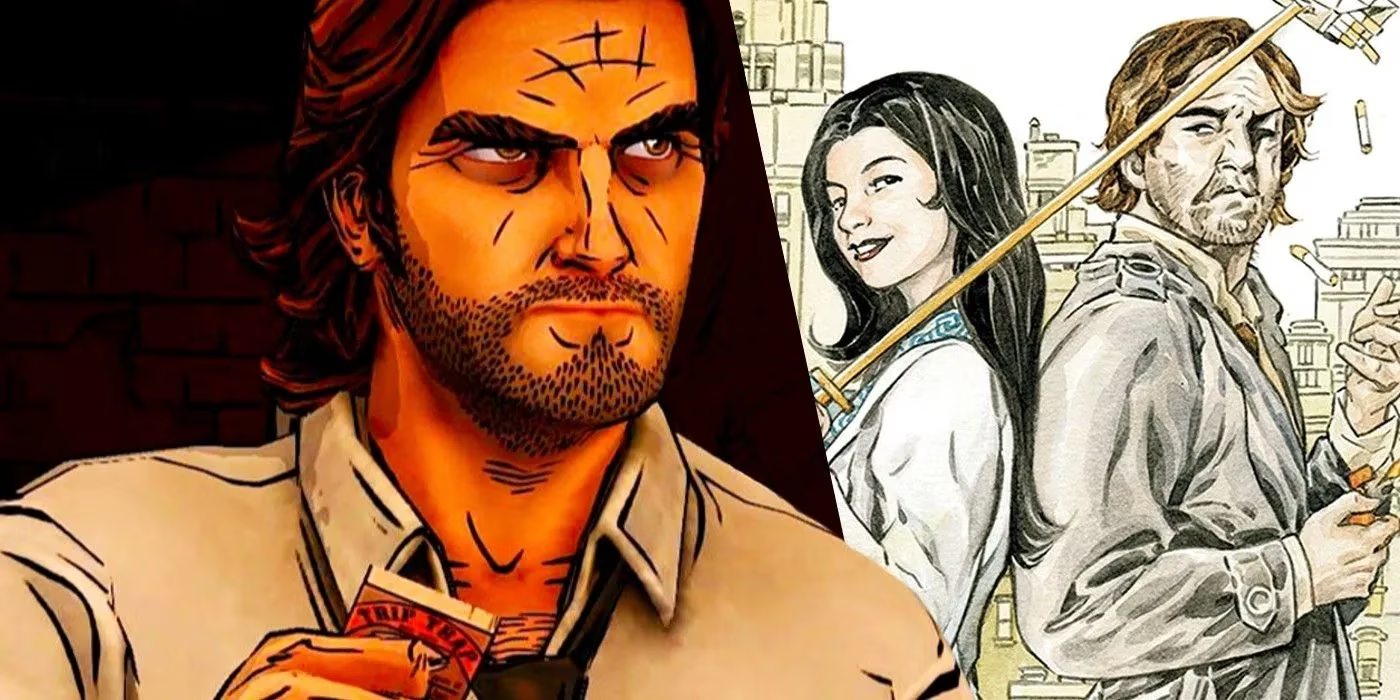
In a seismic shift for the comic book industry, Bill Willingham, the acclaimed creator of the beloved Fables series, has unilaterally released the entire franchise into the public domain as of September 15, 2023. This unprecedented move, announced via his personal blog These Foolish Games, is the culmination of a protracted and increasingly acrimonious dispute with DC Comics, the series' longtime publisher. Willingham, citing a fundamental breakdown in trust and repeated contractual violations by the corporate giant, has chosen to gift the intellectual property—encompassing characters like Bigby Wolf, Snow White, and the entire universe of exiled fairy tale beings—to the world. His action places Fables alongside cultural icons like Sherlock Holmes and Winnie-the-Pooh, theoretically freeing fans and creators to produce new stories, games, and merchandise without seeking permission, while Willingham himself remains contractually bound to DC for existing publications.
The Core Conflict: A Marriage Gone Sour
Willingham's detailed statement paints a picture of a relationship that deteriorated from a partnership of mutual respect into what he describes as an "unhappy marriage" from which he cannot escape. He traces the roots of the conflict to a change in corporate culture at DC Comics over the past two decades. "When I first signed my creator-owned publishing contract with DC Comics," Willingham writes, "the company was run by honest men and women of integrity." He claims that as those individuals departed, they were replaced by executives "of no measurable integrity" who systematically reinterpreted every facet of their agreement to solely benefit DC and its parent companies.
The final straws, according to Willingham, were numerous and severe:
-
Ownership Strong-Arming: During negotiations for the 20th-anniversary continuation, The Black Forest, DC's legal team allegedly attempted to reclassify the work as "work for hire," a move that would have irrevocably transferred ownership to DC. When challenged, their reported excuse was, "Sorry, we didn't read your contract."
-
Creative Disregard: DC executives allegedly admitted they believed they could alter stories, characters, and premises in any way they saw fit, with no obligation to protect the integrity of the IP, even from third-party licensees like Telltale Games.
-
Financial Disputes: Willingham accuses DC of consistent underreporting and late payment of royalties. A particularly galling instance involved money owed from the licensing deal for the hit game The Wolf Among Us. After verbally agreeing to pay, DC allegedly reneged, offering the sum as a "consulting fee" bundled with a non-disclosure agreement to avoid setting a precedent.
"They practically dared me to sue them," Willingham states, acknowledging that a legal battle would be a financially ruinous and years-long process for a 67-year-old creator. Instead, he opted for what he calls "asymmetric warfare," leveraging the one uncontestable clause in his contract: his sole ownership of the Fables IP.
A Philosophical Stand Against "A Mishmash of Unethical Backroom Deals"
Willingham's decision is not merely reactive; it is a proactive stand based on a radical philosophical shift regarding intellectual property law. He proposes a reformed system where:
-
A creator owns an IP exclusively for 20 years after first publication.
-
The creator may then sell it to another entity for exclusive use for a maximum of 10 years.
-
After that, without exception, the property enters the public domain.
In this model, no corporate entity could hold exclusive rights in perpetuity. "The current laws are a mishmash of unethical backroom deals to keep trademarks and copyrights in the hands of large corporations," Willingham argues, viewing his release of Fables as practicing what he preaches. Letting go of his "baby" after twenty years is his first test of this principle. The Fables universe, once a carefully tended garden, has now been opened as a public commons, a move as disruptive as unlocking a storybook and scattering its pages to the wind for anyone to reassemble.
The Public Domain Paradox: Freedom for All But the Creator
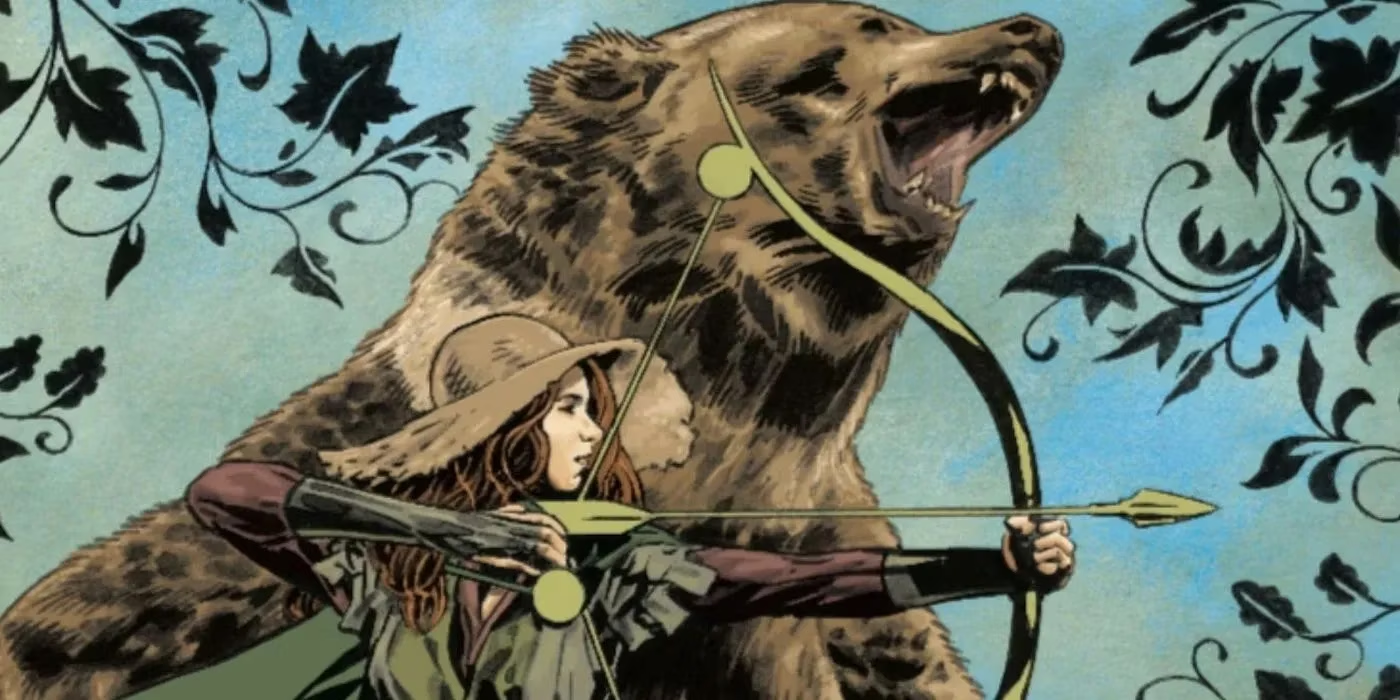
The resulting situation is rich with irony. While fans and other creators are now theoretically free to publish new Fables comics, produce films, or create merchandise, Bill Willingham is not. His publishing and media rights agreements with DC remain in force, binding him to the publisher like an unbreakable storybook curse. He cannot publish new Fables comics elsewhere or authorize adaptations. His statement is a poignant invitation to the world: "Mark Buckingham is free to do his version of Fables... Steve Leialoha is free to do his version... You don’t have to get DC’s permission, or the permission of anyone else."
This creates a bizarre legal landscape. DC retains the rights to publish the existing catalog and any new material from Willingham, but they now compete with a global public that owns the same core IP. The potential for conflict is immense, especially regarding trademarks on names and logos, which Willingham acknowledges remain a "murky" area of law.
Part of a Larger Industry Narrative
Willingham's explosive allegations are not an isolated incident but rather a loud chapter in a growing anthology of creator discontent with major comics publishers. His story echoes the historic struggles of legends like Jack Kirby and Bill Finger, who created iconic characters but saw minimal compensation, and aligns with modern criticisms voiced by creators like Ta-Nehisi Coates and Robert Kirkman. These narratives often highlight a systemic imbalance where corporate machinery profits exponentially from creative genius that it fails to adequately respect or remunerate.
The Fables case is particularly striking due to the series' critical stature and ongoing commercial life, with a sequel to The Wolf Among Us game in development. For a property of this value to be voluntarily released into the public domain is almost without precedent in modern comics, an act as startling as a master architect donating a still-inhabited skyscraper to the city at large.
The Uncharted Future
As of 2026, the long-term consequences of Willingham's decision are still unfolding. The move challenges the very bedrock of corporate IP management and could inspire other frustrated creators. It raises profound questions:
-
Will DC attempt legal countermeasures, perhaps focusing on trademark claims?
-
How will the market respond to a flood of fan-created Fables content?
-
Does this set a new, extreme precedent for creator-owned disputes?
Willingham concludes his statement with a mix of weariness and hope: "It was my absolute joy and pleasure to bring you Fables stories for the past twenty years. I look forward to seeing what you do with it." He has transformed his personal battle with a corporate Goliath into a grand, irreversible experiment, turning his cherished creation into a shared myth for the modern age. The community of Fabletown has, in a meta twist, truly escaped its corporate overseers, and its future is now a story to be written by everyone.