It’s been over a decade since I last wrapped my fingers around the steam-powered gauntlets of Albion, yet the crackle of Will—the raw, intoxicating force of magic in the Fable series—still hums in my memory like a half-remembered melody. In 2026, as the games industry buzzes with news of a resurrected Fable at Playground Games, I find myself returning to 2010’s Fable 3 not for its kingdom-management drama or its controversial third-act pivot, but for something far more personal: its forgotten combat choreography. Many players dismissed the game's spellcasting as a watered-down afterthought, but for me it was a sandbox of destruction that felt closer to conducting a storm than pressing buttons. The truth is that Fable 3’s magic system, overlooked beneath a tide of criticism about repetitive missions and lackluster enemy variety, remains one of the most inventive combat mechanics I’ve ever wielded—and I’m desperate to see its spirit reborn in the coming sequel.
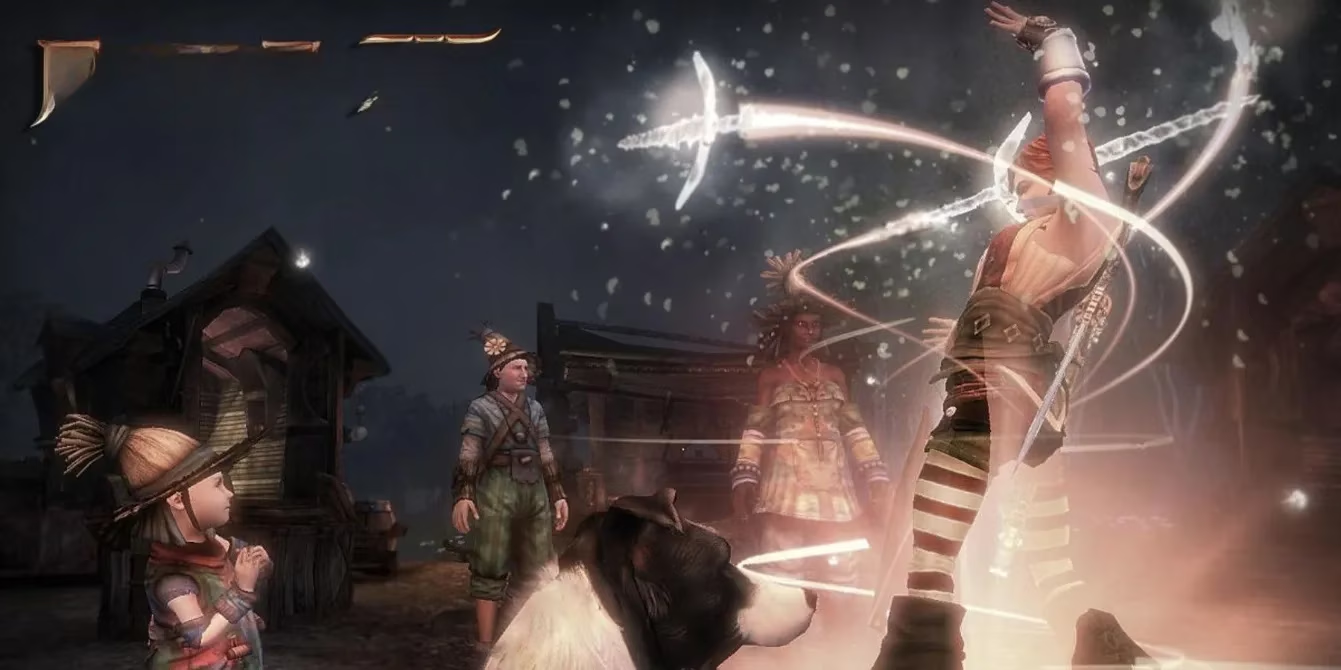
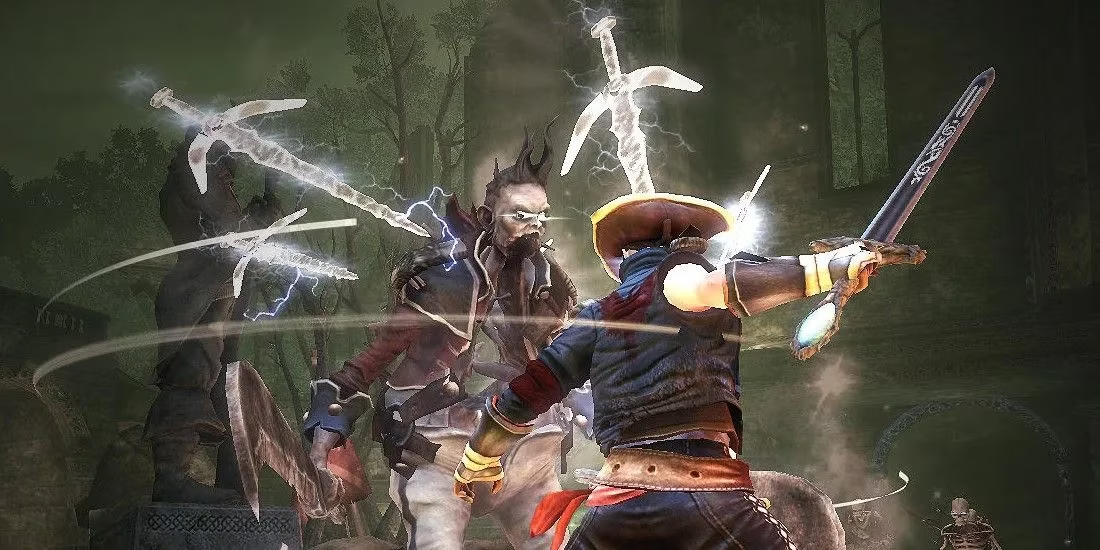
The vocabulary of Will in Fable 3 was deceptively simple: six base spells—Fireball, Shock, Ice Storm, Vortex, Blades, and Force Push—channeled through a pair of steampunk gauntlets that made you feel like a Victorian-era Tesla coil wrapped in leather. Each spell could be charged while stationary, glowing hotter until it erupted with devastating area-of-effect damage, but that momentary vulnerability demanded tactical awareness rather than mindless hammering. The real sorcery, however, was the Spell Weaving. By slotting two spells together, you created hybrid effects that transformed the battlefield into a living canvas. Combining Force Push with Shock turned a simple repulsion wave into a paralysing gust that sent Hobbes tumbling backward in spasms, as if I’d bottled a thunderstorm and forced it into a directional blast. Mixing Blades with Vortex crafted a tornado of slicing metal that spun enemies in a lethal pirouette before flinging them off cliffs with the casual disdain of a bored god. This wasn’t mere spell combination; it was like alchemising a scream with a whisper to produce a symphony of controlled chaos.
What elevated Spell Weaving beyond a standard “combo system” was its fluidity and the sheer sense of improvisation it granted. I remember one midnight session where, besieged by balverines in Silverpines, I switched on the fly from a defensive crowd-clearing Ice Storm/Vortex to a single-target Shock/Fireball lance that cooked my foe from the inside out, the transition as seamless as a dancer switching partners. The game never telegraphed these possibilities with a tutorial pop-up; it trusted you to experiment, to treat each gauntlet as an instrument. In an era where many action-RPGs reduced magic to static hotbar bloat, Fable 3 made you feel like a duellist juggling elemental poetry. The sight of two spells merging in my hands resembled the moment a glassblower twists molten silica into a glowing vessel—brief, beautiful, and utterly fragile—and that fragility gave every fight a snap of adrenaline that the game’s swords and rifles could never match.
Of course, the world of Fable 3 was drifting away from the fairy-tale weirdness that had defined its predecessors. Industrialisation had replaced Albion’s forests with smokestacks and workhouses; my hero wielded flintlock pistols and wore factory-produced uniforms rather than enchanted plate. Magic, with its roots in ancient bloodlines and whimsical lore, felt like a fading art—an echo of a more innocent Albion. Some critics argued that this thematic tension weakened the game’s identity, as if the series had traded its soul for a top hat and a factory deed. Yet for me, this friction was exactly what made the magic so poignant. Casting a charged Vortex in the midst of a sooty mill district felt like remembering the taste of honey in a room full of rust. The gauntlets themselves embodied that duality: their brass pipes and pressure gauges made Will look like a steam-age science, a deliberate conflation of magic with machine that mirrored the game’s own uncertain heart. It was as if Albion was trying to rationalise its own mythology, to weld the fantastical onto the industrial with sweating, desperate hands.
Revisiting Fable 3 now, I appreciate this tension more than I did in 2010. My personal journey with the game is littered with minor heartbreaks—the rushed third act, the forgettable final boss, the PC version’s stuttering frame rate that would hiccup at the worst possible moment—but Spell Weaving remains a bright, untarnished gem. It’s the one feature that makes me fire up the old Xbox 360 emulator on a rainy afternoon, just to chain a Force Push/Blades combo that sends a wave of spectral knives screaming through a pack of hollow men. The system didn’t just bolster combat; it mirrored the player’s growth in a way that simpler leveling systems cannot. When I finally unlocked enough spiritual currency to dual-weave Fireball and Shock, transforming a skirmish into a canvas of crackling, flaming pandemonium, I felt like a maestro who had earned his orchestra.
With Playground Games’ upcoming Fable confirmed for PC and Xbox Series X/S, my hopes are a mixture of excitement and trepidation. The teaser trailers hint at a return to a more folkloric Albion, full of giants and woodland magic, which suggests that the developers might want to distance themselves from Fable 3’s industrial aesthetics. But I pray they don’t discard the mechanical inventiveness that made its combat so special. A modern interpretation of Spell Weaving could be revolutionary—imagine three-slot combinations, or Will effects that interact with environment physics to create chain reactions of ice and lightning across waterlogged terrain. The freedom to sculpt spells like a potter shaping wet clay, not just selecting them from a radial menu, would honour the Fable tradition of letting players feel like cheeky demigods. Even without those innovations, simply carrying forward the original’s binary spell fusion would be a statement: that despite all its stumbles, Fable 3 understood that the soul of Albion isn’t just in its satire or its morality, but in the raw, tactile joy of breaking the world with your fingertips.
As I close the dust-covered journal of my last playthrough, I’m reminded that the best magic systems aren’t measured by the size of their fireballs but by the space they leave for wonder. Fable 3 gave me that space in abundance, wrapped inside a flawed but fiercely creative package. Fourteen years later, with a new chapter on the horizon, I’m ready to feel that static-electric crackle again—and this time, I hope the whole series gets to dance in the storm I’ve been waiting to conduct.