In the vast and varied tapestry of video game worlds, certain environmental themes have become beloved staples. From lush grasslands to treacherous ice caps, these familiar settings provide a foundational language for developers and players alike. Yet, among these classic biomes, the desert stands apart. Far from being a monotonous sea of sand, the concept of a 'desert' in interactive entertainment is a remarkably flexible canvas, interpreted in wildly creative and distinct ways across countless titles. As we look back from the vantage point of 2026, the legacy of these digital wastelands—ranging from sun-scorched dunes to post-apocalyptic badlands—remains a testament to the enduring power of imaginative world-building. These are not merely backdrops; they are characters in their own right, shaping narratives, mechanics, and player memories with their harsh beauty and hidden secrets.
🏜️ The Classics: Foundations of Sandy Fun
No discussion of gaming deserts can begin without tipping a hat to the masters of the craft at Nintendo. The Mario franchise has long been a pioneer, establishing iconic sandy playgrounds that balance whimsy with challenge.
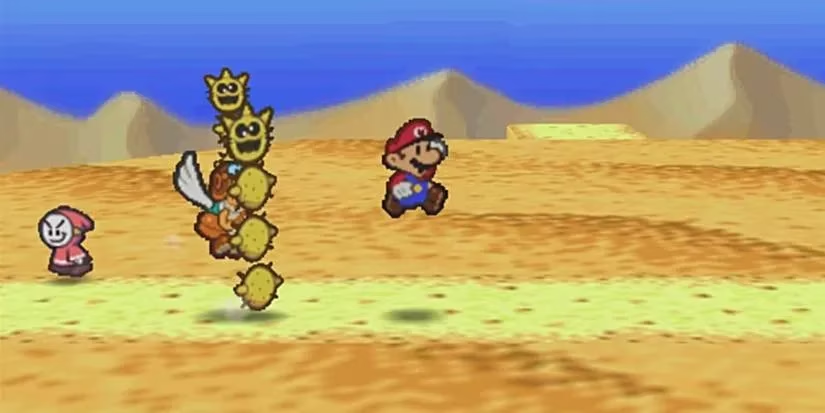
Dry Dry Desert from Paper Mario remains a benchmark. On the surface, it's a charming, maze-like expanse of dunes leading to ancient ruins. Yet, its true magic lies in the depth of its optional exploration. Beyond the critical path to the Dry Dry Outpost and the chapter's main objectives, the desert hides a plethora of unique rooms and secrets, rewarding players who dare to get truly lost in its sun-baked corridors. It’s a masterclass in making a seemingly straightforward environment feel endlessly discoverable.
Following in those footsteps but carving its own path, Bug Fables presents the Lost Sands. This locale cleverly reinterprets the desert not just as a place to wander, but as a massive, multi-layered puzzle. Progress through this bandit-infested wasteland requires players to actively open new routes and solve environmental conundrums. The delightful twist? Upon completing the arduous trek, the revelation that this entire sprawling desert existed within a mere sandbox adds a layer of meta-humor and brilliant scale that few other games have matched.
🌵 Beyond the Dunes: Deserts of Despair and Personality
Not all deserts are rolling golden hills. Some reflect a more brutal, realistic, or thematically rich desolation.
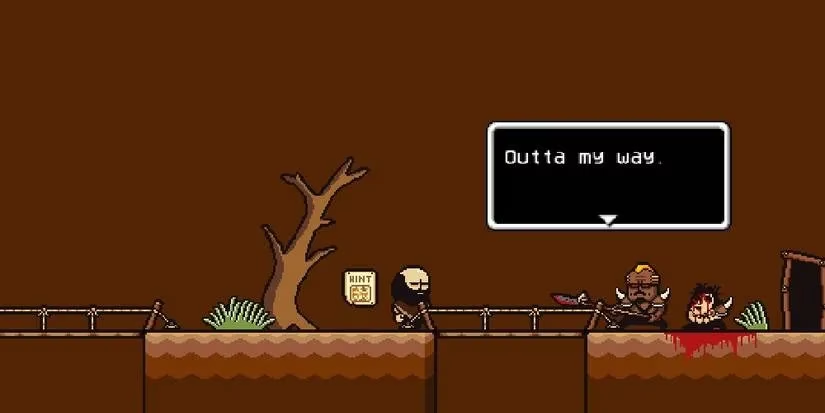
Olathe from Lisa: The Painful presents a desert of a different color: a post-apocalyptic American wasteland. Barren, resource-scarce, and littered with the detritus of a collapsed civilization, Olathe's primary feature isn't its geography but its inhabitants. The land is ruled by bizarre, Mad Max-inspired warlords and their gangs, each with insane cult-like quirks—from worshipping a man's beauty to mandating hair and executing the bald. The desert here is a character, a blank slate upon which human madness and desperation are writ large, making every journey across its cracked earth a tense and unforgettable narrative experience.
In a completely different tonal shift, Bugsnax's Sizzlin' Sands proves that even a 'generic' desert can be unforgettable with the right twist. This late-game area is a massive, playful sandbox dotted with ruins and a central oasis. It's home to some of the game's most aggressive edible creatures, like the fiery Picantis and imposing Buffalocust, making capture a tricky endeavor. Yet, by night, the oasis becomes a serene spot for reflection. The area masterfully blends tension with tranquility, embodying the dual nature of a desert: a place of danger and a place of peace.
🛡️ Vast and Living Worlds: Deserts as Expansive Playspaces
Some games use the desert not just as a level, but as the foundation for an entire living, breathing world.
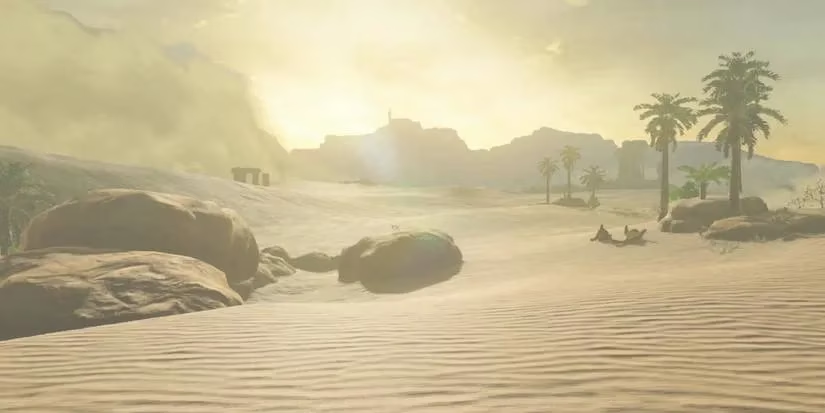
The Gerudo Desert in The Legend of Zelda: Breath of the Wild is a masterpiece of environmental design. It is vast, harsh, and demands preparation, requiring specific gear to survive its blistering days and freezing nights. The constant struggle against the slowing sands is mitigated only by the exhilarating use of Sand Seals. At its heart lies Gerudo Town, a vibrant, female-only bastion of culture and trade, with Link's cross-dressing infiltration standing as one of the series' most iconic and humorous moments. The desert is packed with secrets, shrines, and stories, encouraging players to pour hours into its exploration.
Similarly, the Mojave Wasteland from Fallout: New Vegas uses its barren expanse to tell a rich, political story. While visually a dry wasteland, it is densely packed with factions, history, and conflict. The struggle between Caesar's Legion, the New California Republic, and Mr. House's New Vegas Strip turns the desert into a dynamic chessboard. Every location, from repurposed old-world buildings to strange Vault experiments, feels grounded in this reactive world. The Mojave doesn't just feel like a setting; it feels like a place with its own momentum, where the player is one influential piece in a much larger, fascinating struggle.
⏳ Mechanics and Magic: When Sand Becomes the Star
The most innovative desert levels are those where the sand itself, or the concept of aridity, becomes the core gameplay mechanic.
The Legend of Zelda: Skyward Sword's Lanayru Desert brilliantly plays with time and ecology. This wasteland was once a lush, ocean-filled land inhabited by advanced robots. The player uses Timeshift Stones to revert small patches of desert to their past glory, temporarily creating pools of water, reviving ancient machinery, and altering puzzles and combat in real-time. It’s a poignant and clever commentary on the nature of deserts themselves—not permanent dead zones, but landscapes changed by time and climate.
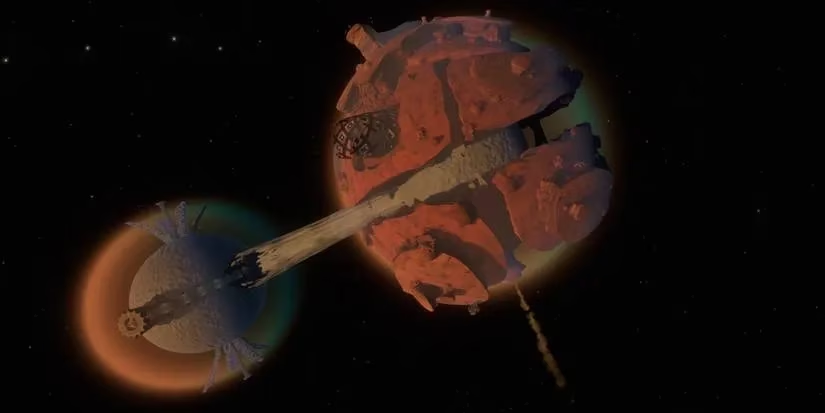
Outer Wilds achieves something truly sublime with the Hourglass Twins. Here, sand is not a static terrain but a dynamic, terrifying force of nature. As the game's 22-minute time loop progresses, sand physically drains from one planet to the other, like a cosmic hourglass. This creates a desperate race against time to explore the buried ancient cities and secrets of Ash Twin before they are swallowed, or to wait patiently as the sands recede from Ember Twin to reveal new pathways. It is a perfect, poetic fusion of environment, mechanics, and the game's central themes of time, exploration, and cosmic scale.
😈 Hell’s Own Wasteland: The Pinnacle of Creative Fury
Topping the list is a desert that defies all earthly logic: Greed, the fourth circle of Hell in the relentless shooter ULTRAKILL. This is a desert of divine punishment—an endless, burning expanse where the ruins of human avarice sink into the sand and the damned are subjected to eternal, Sisyphean labor. The creativity is off the charts:
-
Sand that actively burns the player.
-
Enemies coated in sand, changing their combat properties.
-
Dark, claustrophobic pyramid interiors to explore.
-
A boss fight that involves literally sand-surfing down the side of a massive monument.
Greed takes every expectation for a desert level and filters it through a lens of hyper-violent, stylish spectacle. It never lets up, making it not only one of the most memorable deserts in gaming but one of the most memorable levels period, a blistering testament to how far the concept can be stretched.
| Desert | Game | Key Defining Feature |
|---|---|---|
| Dry Dry Desert | Paper Mario | Deep, secret-filled optional exploration |
| Lost Sands | Bug Fables | A desert structured as a massive, solvable puzzle |
| Olathe | Lisa: The Painful | A post-apocalyptic wasteland defined by its insane inhabitants |
| Sizzlin' Sands | Bugsnax | A playful sandbox blending aggressive creatures with serene peace |
| Gerudo Desert | The Legend of Zelda: Breath of the Wild | A vast, harsh, and culturally rich open-world region |
| Mojave Wasteland | Fallout: New Vegas | A politically charged, reactive world built on a desert canvas |
| Lanayru Desert | The Legend of Zelda: Skyward Sword | Time-shifting mechanics that restore a desert to its lush past |
| Hourglass Twins | Outer Wilds | Sand as a dynamic, planet-scale timer within a time loop |
| Greed | ULTRAKILL | A hellish desert of burning sand and relentless, stylistic action |
From the classic fun of Mario's dunes to the existential time puzzles of Outer Wilds and the infernal fury of ULTRAKILL, gaming's deserts prove that this theme is far from barren. They are spaces of paradox—simultaneously empty and full of secrets, hostile and beautiful, timeless and constantly changing. They challenge the player, not just with enemies and obstacles, but with the environment itself. As game design continues to evolve, one can only imagine what new, breathtaking wastelands await over the next digital horizon, ready to capture our imaginations with their siren song of sun, sand, and sublime adventure.