I still remember the day I first stumbled into Albion like a drunken hobbe at noon. The sky was a watercolor of bruised purples, the Guild of Heroes loomed like a disapproving uncle, and a chicken—a single, feathered menace—pecked my shin until I accidentally kicked it sixty yards into a hedge. That, my friends, is Fable in a nutshell: grandiose, ridiculous, and so utterly, brilliantly British that I almost expected the game to offer me a cup of tea after every quest. When Lionhead Studios shuttered in 2016, taking Fable Legends with it, I genuinely felt like I’d lost a childhood mate—one who always had a bawdy joke and a questionable haircut. I spent months sighing dramatically at my Xbox, convinced that the wild hills of Bowerstone and the eerie glow of Wraithmarsh would never grace my screen again.
But then… a glimmer! In 2020, Microsoft waved its magic wand and declared that Playground Games was cooking up a brand-new Fable, a reboot that would wipe the slate clean while somehow cradling our nostalgia. Fast-forward to 2026, and I’m practically vibrating with anticipation—though I’ve worn out four keyboards refreshing news feeds and the only official thing we’ve got is that glossy teaser trailer that still makes me weep into my pillow. The gaming world is drowning in rumors: time travel, interplanetary chickens (please, gods, let there be interplanetary chickens), and a whole new Albion that’s literally been dusted by a meteor and rebuilt from the mud. Nothing solid, mind you. Just whispers that make my heart hammer like a balverine on a full moon. But I’ll tell you this for free: whatever wild, dimension-hopping shenanigans the new Fable throws at us, it had better doff its cap to the studio that birthed the whole daft, glorious mess. If I don’t see a massive, unsubtle, tongue-in-cheek tribute to Lionhead, I’ll storm Playground’s office in a chicken suit myself.
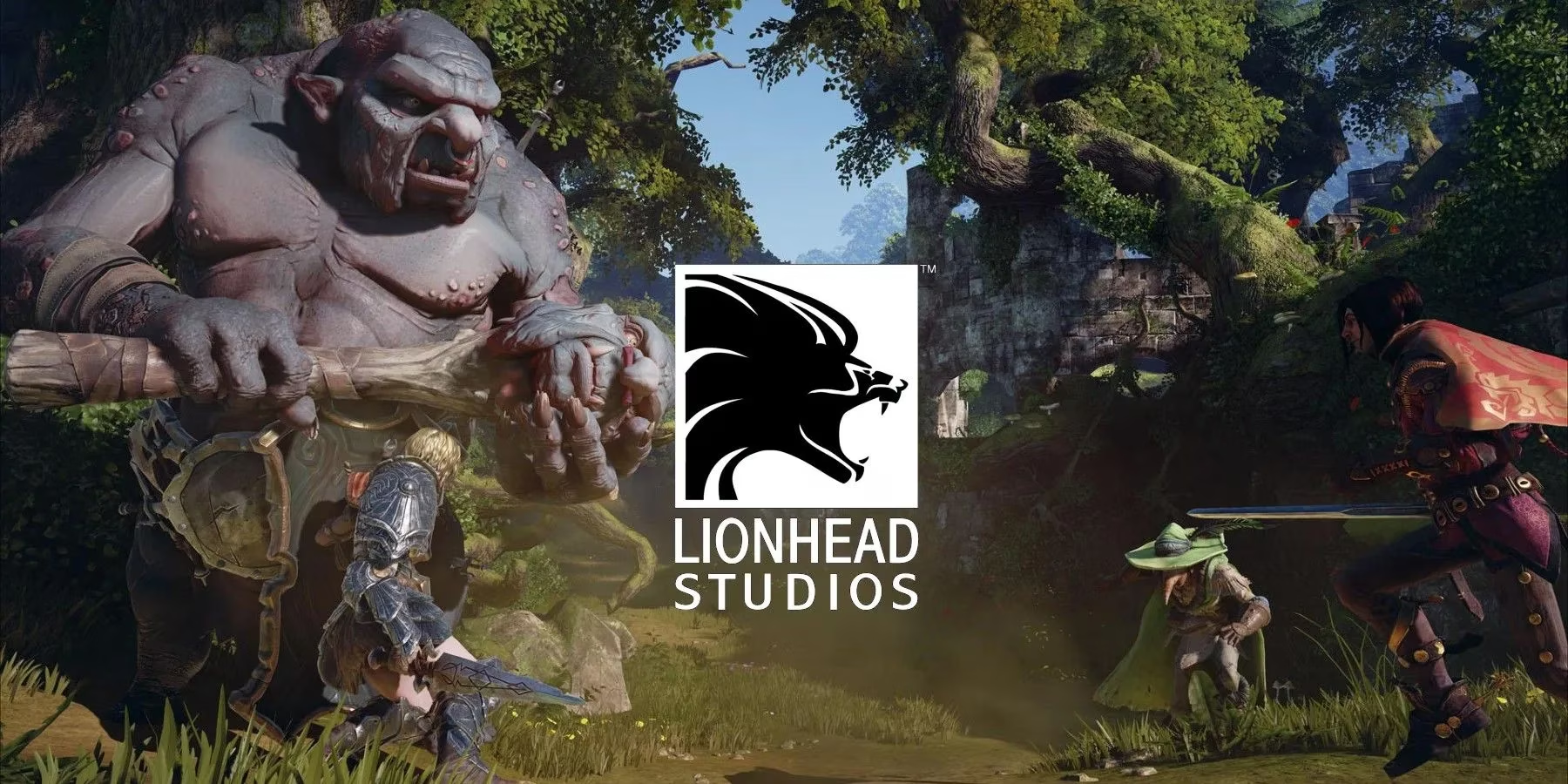
Let’s be real: Lionhead didn’t just make action RPGs; it poured a pint of irreverence into every pixel. The combat was a lark—you could boot a bandit so hard he’d cartwheel into a barrel, then pause to fart on a villager for a laugh. The art style was this dreamy, almost storybook cartoonishness that made even demon doors look like they were in on the joke. And the morality? Oh, the morality! You could be a halos-and-harps hero, sure, but the real art lay in growing horns, eating live chicks, and convincing an entire town you were just “having a bad day.” Every Fable game swaggered along with a wink and a nudge, reminding players that life—even one stuffed with prophecies and sword fights—was too short for solemnity. There were tears too, of course. I still can’t watch the ending of Fable 2 without sobbing into my controller. But the series’ heartbeat was always that ridiculous, uniquely British sense of humor, as dry as stale scones and twice as unexpected. Hedge mazes that mocked you, quest givers who insulted your ancestry, and gnomes who spat one-liners while you kicked them into the stratosphere. It was chaotic, madcap, and utterly irreplaceable.
And here’s the kicker: Playground Games, bless its Forza-bred soul, is also as British as a rainy August bank holiday. Back in 2021, Phil Spencer himself promised the Xbox faithful that Fable would remain “a little more British” and that Playground would keep it there. I recall watching that interview, fist-pumping so hard I nearly dislocated my shoulder. This wasn’t just lip service—it was a declaration that the soul of the franchise wouldn’t be outsourced into generic fantasy mush. Playground has miles of experience building lush, vibrant worlds, and I’d trust them to sculpt a hilltop village or a cursed forest any day. But world-building alone won’t cut it. The new Fable needs to feel like a spiritual successor, to capture that same mischievous glint, so that when I draw my sword for the first time, I half-expect a crumpled note from Lionhead to fall out of the scabbard. The DNA has to be there, woven so tightly into the code that you can practically smell the pork pies.
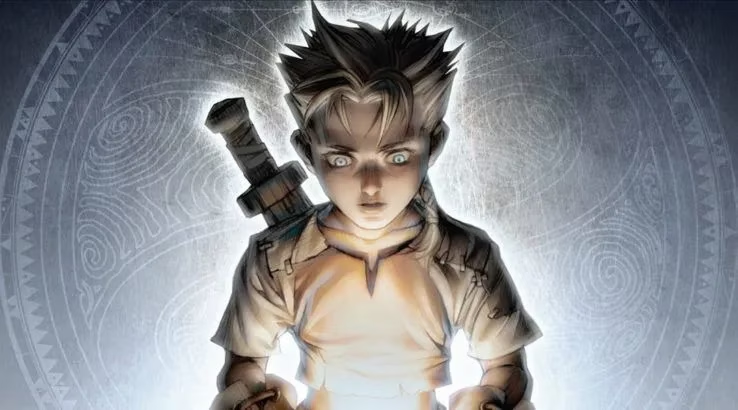
Now, about those rumors… You’ve got to be kidding me with this interstellar nonsense, right? Since the reboot was announced, the rumor mill has churned out stories that sound like they were scribbled on napkins after a few too many ales. Supposedly, Albion and Aurora got blattered by a meteor eons ago, and the new game takes place in a distant future where humanity has clawed back to a medieval-ish level, complete with swords, sorcery, and possibly the ghosts of old Heroes. Some leaks whisper about time travel and hopping between planets, which—honestly?—could be either the greatest thing since sliced Hobbe or a complete disaster. I’m trying to keep an open mind, but every time I hear “planets,” I picture my Hero riding a rocket-powered chicken and shouting profanities at moon-dwellers. And you know what? If that’s the direction, fine—I’ll embrace the lunacy. But I’ll also be scouring every corner of those alien worlds for a plaque, a statue, or a slapstick NPC who’s clearly a caricature of a Lionhead developer. The original studio’s fingerprints should be smudged all over this thing, like a child’s handprints on freshly polished armor.
Game development is a howling beast, and I understand that Playground might want to carve its own legend. Rebooting a series is nerve-wracking; you’re dancing on a tightrope strung between nostalgia and innovation. But forgetting Lionhead would be like serving a victory feast without ale—technically possible, but a crime against all that is decent. Even the missteps, like Fable 3’s slightly wonky menu system or the ill-fated Fable Legends, were part of the journey. They taught us that Albion was a living experiment, a place where risks were taken, where you could marry eight spouses and then accidentally sacrifice one to a dark god without the game batting an eye. I’m not asking for a carbon copy. I’m begging for a knowing wink. Maybe a hidden quest where you retrieve a “legendary artifact” that turns out to be a crumbly old hard drive labeled “Lionhead Memories.” Or a tavern bard who sings a mournful ballad about a studio that “dreamt in blue and green pixels.” Heck, I’d settle for a cheeky tombstone in a graveyard that reads “Here lies the developer who thought chicken-chaser was a safe profession.” Something—anything—to prove that the new stew has the same secret ingredient as the old.
As 2026 grumbles on and the release date remains infuriatingly vague, I find myself replaying the old games like a lovestruck fool. I’ll boot up Fable 2, rescue my dog (again), and marvel at how a game from 2008 can still make me cackle when I hit a guard in the face with a slap. The franchise’s heart isn’t just nostalgia—it’s a masterclass in how to balance epic stakes with the absurdity of existence. Playground Games stands at a crossroads, axe in one hand and a comedy chicken in the other. If they deliver a Fable that respects its Lionhead lineage while propelling it into the stratosphere (possibly literally), I’ll be the first to raise a tankard. If they ignore those roots, though, I’ll be sorely tempted to dig out my old Hero Guild seal and lodge a very British complaint—polite in tone, devastating in subtext. So come on, Playground. Make us proud. Make us laugh until our sides split. And for the love of Avo, stick a massive, unmissable tribute in there, because Lionhead’s spirit is too cheeky, too brilliant, and too stubborn to be left gathering dust in Albion’s attic.