In the vast and intricate tapestry of video game creation, countless threads are spun, woven with ambition and artistry, only to be severed before the final pattern can be revealed. These are the phantom games, the echoes of unborn worlds that haunt the collective memory of players and creators alike. Their stories are not of failure, but of potential unfulfilled, casualties of corporate upheaval, financial ruin, and creative disputes. They linger in the imagination like half-remembered dreams, their brilliance a ghostly promise of what might have been.
Among these spectral titles, Eternal Darkness 2 stands as a particularly poignant specter. The original Eternal Darkness: Sanity’s Requiem was a masterpiece of psychological horror for the GameCube, its sanity effects warping reality itself for the player. Its planned sequel was a dream held by developer Silicon Knights, a dream that would be consumed by a legal inferno. Following the release of Too Human, the studio became embroiled in a bitter, five-year legal battle with Epic Games over the Unreal Engine 3. The studio's defeat was catastrophic, a financial and creative collapse that forced them to destroy unsold games and file for bankruptcy. Eternal Darkness 2 vanished into the void, a brilliant idea extinguished not by lack of vision, but by contractual warfare, its fate sealed as irrevocably as a tomb.
Similarly, the whimsical world of Albion was poised for a new kind of adventure with Fable Legends. Developed by Lionhead Studios, this multiplayer title aimed to reinvent the Fable formula, casting four players as heroes and a fifth as a villainous game master. Yet, the studio itself was undergoing a slow, quiet dissolution. After Fable 3, a focus on Kinect projects and a talent exodus left the company adrift. By 2016, Microsoft made the decision to close Lionhead's doors. Fable Legends was canceled, its potential for chaotic, cooperative fun lost—a vibrant carnival tent folded up and stored away before the first show could begin. The closure was like watching a beloved storyteller forget the ending to their own tale.
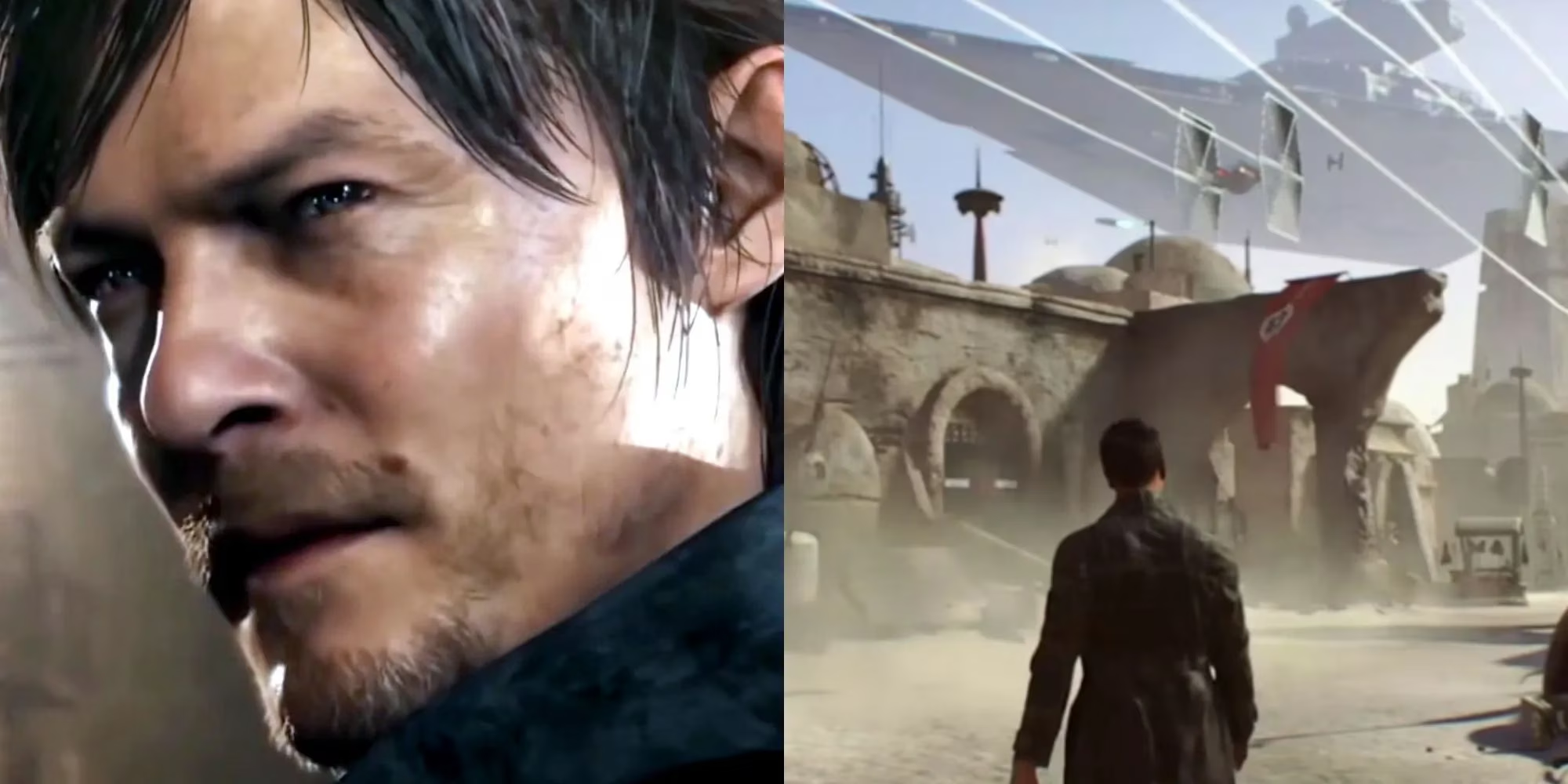
The Star Wars galaxy, so rich with stories, has proven to be a treacherous asteroid field for game developers. Two projects, in particular, met their end with the closure of their studios. The first, Star Wars 1313, promised a gritty, bounty-hunter-centric adventure with direct involvement from George Lucas. It was a beacon for fans craving a mature take on the universe. However, Disney's acquisition of Lucasfilm in 2012 led to LucasArts being gutted, its development staff laid off. 1313 was instantly scrapped, its promising underworld narrative abandoned like a starship drifting derelict in deep space. Its trademark has been considered abandoned since 2014, making a return as likely as finding a single, specific grain of sand on Tatooine.
Not long after, Project Ragtag suffered a similar fate. This heist-based adventure from Visceral Games (creators of Dead Space) and directed by Uncharted veteran Amy Hennig was an exciting prospect. Yet, following the success of the multiplayer-focused Star Wars Battlefront, EA pivoted its strategy. Visceral Games was gradually downsized and then closed in 2017. Project Ragtag was briefly transferred before being fully canceled. While Jedi: Fallen Order later filled the single-player void, Ragtag's specific tale of scoundrels and schemes remains untold, a meticulously planned heist where the vault door was welded shut before the team could even arrive.
The realm of horror has seen its share of phantoms, none more intriguing than Guillermo del Toro's Insane. Announced in 2010 as a trilogy crafted by the visionary filmmaker, it was a passion project poised to blend cinematic terror with interactive storytelling. Its cancelation in 2012 was mysterious at the time, but it soon became a symptom of a larger sickness. Publisher THQ was collapsing under financial strain, declaring bankruptcy just months later. Insane was a casualty of this corporate decay, a beautiful and terrifying sculpture left half-carved in a workshop that was suddenly boarded up and forgotten.
Del Toro's cursed journey in gaming did not end there. He later collaborated with Hideo Kojima on Silent Hills, announced through the legendary and terrifying P.T. demo. This fusion of talents—Kojima's mind-bending design, del Toro's gothic sensibility, and Norman Reedus's starring role—promised a revolution in horror. But Konami's infamous pivot away from major game development led to a bitter split with Kojima. Silent Hills was canceled, and P.T. was pulled from digital stores, becoming a forbidden artifact. The collaboration found new life in Death Stranding, but Silent Hills persists as the ultimate "what if," a haunted house whose front door was forever locked, leaving players to forever peer through the crack, wondering at the nightmares within.
| Game | Developer | Reason for Cancelation | Year Canceled |
|---|---|---|---|
| Eternal Darkness 2 | Silicon Knights | Studio Bankruptcy (Post-Legal Loss) | ~2013 |
| Fable Legends | Lionhead Studios | Studio Closure by Microsoft | 2016 |
| Star Wars 1313 | LucasArts | Studio Gutted After Disney Acquisition | 2013 |
| Project Ragtag | Visceral Games | Studio Closure by EA | 2017 |
| Insane | THQ / Guillermo del Toro | Publisher Bankruptcy | 2012 |
| Silent Hills | Kojima Productions / Konami | Corporate Restructuring & Director Firing | 2015 |
These stories form a silent chorus in the industry's history. They remind us that the games we play are miracles of stability, the survivors of a turbulent and often unforgiving process. The phantom games are their shadow-selves, concepts that burned brightly before being snuffed out by winds beyond their creators' control. They exist now as lore, as cautionary tales, and as a testament to the fragile nature of artistic creation in a commercial world. In 2026, we can only look back and wonder, listening for the echoes of these unborn worlds that continue to resonate in the silence.